

The Difference Between Monitoring and Observability
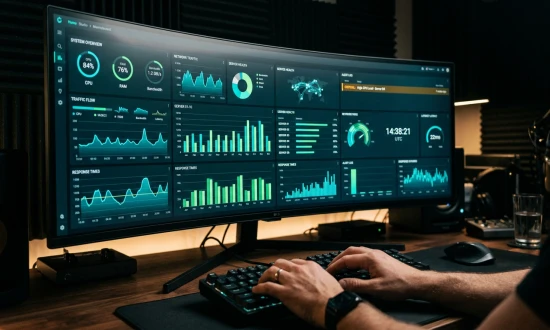
Monitoring and observability are frequently conflated, but they represent different approaches to understanding system behavior. Monitoring is the practice of watching predefined metrics and alerting when they cross thresholds: CPU utilization above 90%, error rate above 1%, latency above 500 milliseconds. Monitoring answers questions you anticipated — questions whose shape you knew when you configured the alerts. Observability is the property of a system that allows you to ask and answer questions you didn't anticipate — to diagnose novel failure modes, trace unexpected behavior, and understand interactions between system components that were not foreseen at design time.
The practical distinction matters enormously in distributed systems. A monolithic application with a handful of components might fail in a small, bounded number of ways that can be comprehensively anticipated and monitored. A microservices system with hundreds of independently deployed services, each with its own failure modes, interacting through networks with their own characteristics, exhibiting emergent behaviors that none of the individual services exhibit alone — this system will fail in ways that were not anticipated. It needs observability, not just monitoring.
The three technical pillars of observability are logs, metrics, and traces. Logs are time-stamped records of events — structured data that captures what happened, when, and in what context. Metrics are time-series measurements of system quantities — request rates, error counts, queue depths, resource utilization. Traces are records of distributed requests — chains of causally related operations that span service boundaries, allowing engineers to follow a single user request as it flows through dozens of services and understand where time is spent and where failures originate.
OpenTelemetry: The Standard That Finally Unified the Industry
For years, the observability tooling ecosystem was fragmented across incompatible vendor formats. Sending data to Datadog required Datadog's SDK. Switching to New Relic required re-instrumenting your entire codebase. The industry recognized this as a collective problem, and the OpenTelemetry project — a CNCF graduated project that emerged from the merger of OpenCensus and OpenTracing — has become the solution. OpenTelemetry defines vendor-neutral standards for generating, collecting, and exporting telemetry data from applications. Instrument once, export to any compatible backend. Every major observability vendor and cloud provider now supports OpenTelemetry, and adoption has exceeded 80% in cloud-native organizations.
Service Level Objectives and Error Budgets
Service Level Objectives (SLOs) — measurable targets for the reliability characteristics of a service, expressed in terms of user-facing outcomes — have become the central organizational mechanism for managing the tension between reliability and velocity. An SLO expresses a commitment: "99.9% of search requests will complete within 200 milliseconds over a rolling 30-day window." The error budget is the complement — the amount of unreliability that is permissible within the SLO: with a 99.9% target, the error budget is 0.1%, or approximately 43 minutes of downtime per month.
Error budgets provide a principled answer to the perennial engineering debate about how much risk is acceptable to ship a new feature. When the error budget is healthy — most of the permitted unreliability remains unspent — teams can ship aggressively and accept higher deployment risk. When the error budget is exhausted — the service has already experienced as much unreliability as the SLO permits — teams shift focus to reliability work and slow or halt feature deployments. This converts an inherently political negotiation between product and operations into a data-driven, rules-based system that both sides can understand and accept.
AI-Powered Observability: The Next Frontier
The scale of telemetry data generated by modern distributed systems has made traditional manual analysis increasingly untenable. A large microservices deployment might generate terabytes of logs, millions of metrics, and hundreds of millions of trace spans per day. No team of engineers can meaningfully analyze this volume manually. AI-powered observability tools are emerging to address this challenge.
AIOps platforms use machine learning to perform anomaly detection across metrics (identifying unusual patterns that don't cross static thresholds), log analysis (clustering and categorizing log events to surface novel patterns), root cause analysis (correlating anomalies across services to identify causal chains), and incident prediction (identifying conditions that historically precede incidents before the incident occurs). Tools like Dynatrace, Splunk, New Relic, and Honeycomb have invested heavily in AI-powered analysis, and the results in production are compelling: mean time to detection (MTTD) improvements of 50–90% in organizations that deploy these capabilities with well-instrumented systems.
Software Quality Engineering as a Practice
Quality engineering is the discipline that ensures software systems meet their reliability, performance, security, and functional requirements — not just at the time of initial release, but continuously as systems evolve. It encompasses testing strategy (unit, integration, contract, end-to-end, chaos), performance engineering (load testing, capacity planning, profiling), security testing (static analysis, dynamic analysis, penetration testing, dependency scanning), and the operational feedback loops that close the gap between development and production behavior.
The shift-left movement — introducing quality practices earlier in the development lifecycle rather than at the end — has been the dominant trend in quality engineering for the past several years. Rather than discovering performance problems in load testing the week before release, performance budgets are defined during design, validated in every pull request, and monitored in production. Rather than scanning for security vulnerabilities in quarterly audits, automated scanners run on every commit. The result is a quality posture that improves continuously rather than degrading between periodic reviews.
In 2026, AI is beginning to augment quality engineering in meaningful ways: generating test cases for new code paths, predicting which changes are most likely to introduce regressions based on historical patterns, analyzing production telemetry to identify reliability risks before they manifest as incidents, and synthesizing test coverage insights that would take engineers weeks to develop manually. Quality engineering is evolving from a reactive function that validates completed software to a proactive discipline that continuously closes the loop between intent and behavior across the entire software lifecycle.