

OVERVIEW
Risk management in software projects has long suffered from a paradox: every team acknowledges its importance, yet most treat it as a compliance checkbox rather than a live operational discipline. The consequences are well-documented — scope creep, blown budgets, missed launches, and reputational damage. What separates high-performing software organizations is not the absence of risk, but their systematic approach to identifying risk early, quantifying its probability and impact, and maintaining active mitigation strategies throughout the delivery lifecycle.
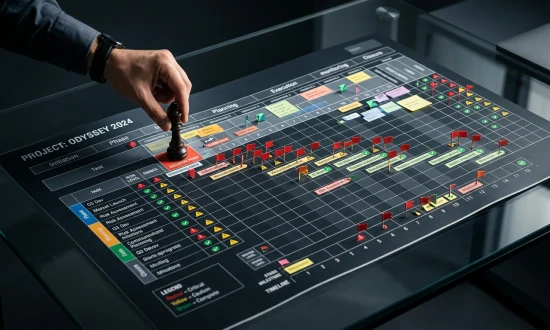
Modern software risk management has evolved significantly beyond static risk registers. Today's leading teams combine Monte Carlo simulations, continuous delivery metrics, and AI-assisted anomaly detection to build dynamic risk profiles that update in real time as the project evolves. Technical debt, third-party dependencies, talent concentration risk, and regulatory exposure have joined the traditional schedule and budget risks as first-class concerns that project leaders must actively track and report to stakeholders.
TWO PERSPECTIVES
Technical Risk Landscape Software-specific risks span architecture decisions, integration complexity, third-party API stability, legacy system coupling, and infrastructure reliability. Technical debt compounds these risks over time, making systems increasingly brittle and expensive to change. Effective technical risk management requires architects and senior engineers to be active participants in project governance, not just delivery. | Delivery & Business Risk Beyond technical concerns, software projects face schedule compression risks, resource bottlenecks, vendor dependency failures, regulatory changes, and market timing pressures. Business risk in software delivery is increasingly tied to speed — delayed launches have compounding opportunity costs, particularly in competitive SaaS markets where first-mover advantage is decisive. |
SDLC PHASE MAPPING
Phase 01 Risk Identification | Cross-functional workshops surface risks from engineering, product, legal, and ops perspectives. Risk taxonomy is established with clear ownership assigned per category from day one. |
Phase 02 Quantification & Scoring | Each identified risk is scored on probability and impact matrices. High-complexity projects apply Monte Carlo simulations to model schedule and budget confidence intervals statistically. |
Phase 03 Mitigation Planning | For every high-priority risk, a concrete mitigation plan is documented — including trigger conditions, response actions, owners, and fallback options if mitigation fails to contain the risk. |
Phase 04 Continuous Monitoring | Risk registers are reviewed weekly, not monthly. Delivery metrics — cycle time, defect rate, deployment frequency — serve as early warning indicators for emerging systemic risks. |
Phase 05 Stakeholder Reporting | Risk status is communicated transparently to stakeholders through tiered dashboards — operational detail for delivery teams, executive summaries for leadership, with trend data showing risk trajectory over time. |
Phase 06 Post-Delivery Review | Risk retrospectives capture which risks materialized, which mitigations worked, and which were missed entirely — feeding an organizational risk knowledge base that improves future project estimation. |
FUTURE OUTLOOK
The future of software project risk management is predictive and continuous. AI models trained on historical project data, commit patterns, and delivery velocity are already beginning to forecast delivery risk weeks before it becomes visible in status reports. As software supply chains grow more complex — with hundreds of open-source dependencies, cloud providers, and third-party APIs — risk management will expand to encompass the entire digital supply chain, not just the code a team writes itself. Organizations that invest now in structured risk data collection will have a compounding advantage as machine learning tools mature, turning historical project intelligence into real-time risk foresight.
KEY TAKEAWAYS
- A risk register updated less than weekly is a historical document, not a management tool — treat risk tracking as a live operational discipline.
- Every risk needs a named owner, a trigger condition, and a documented response plan — generic entries with no accountability provide false security.
- Technical debt is a risk, not a backlog item — it should be quantified, tracked, and communicated to stakeholders with the same rigor as schedule risk.
- Third-party dependencies (APIs, vendors, open-source libraries) must be included in risk assessment — supply chain failures are now among the most common project disruptors.
- Delivery metrics — deployment frequency, change failure rate, mean time to recovery — are leading indicators of project risk, not lagging ones.
- Risk communication to executives should be visual, trend-based, and exception-driven — not buried in project status documents nobody reads.
- Talent concentration risk (key-person dependency) is one of the most underreported risks in software projects and one of the most damaging when it materializes.
- Post-delivery risk retrospectives are not optional — organizations that skip them repeat the same failure patterns across successive projects.