

Introduction
Software development has always been an exercise in managing uncertainty. Requirements that seemed clear at the start of a project evolve as stakeholders see early prototypes. Market conditions shift, rendering planned features obsolete before they ship. Technical discoveries reveal that the architecture assumed at the outset will not support what the product actually needs to become. For most of the industry's history, the standard response to this uncertainty was to try to eliminate it — to spend months gathering requirements, documenting them exhaustively, designing the complete system upfront, and then executing the plan as specified.
The results were often disastrous. The Standish Group's CHAOS Report, which has tracked software project outcomes since 1994, has consistently found that a large majority of software projects delivered late, over budget, or with significantly fewer features than planned. Many were cancelled outright. The waterfall model — named for the way work cascaded in one direction from requirements through design, development, testing, and deployment — was effective for predictable, well-understood work, but software development is rarely either.
Agile methodologies emerged from the recognition that software development is not a manufacturing process but a knowledge work discipline — one that requires continuous learning, adaptation, and collaboration. The 2001 Agile Manifesto, signed by seventeen software practitioners, articulated a set of values and principles that have since transformed the industry: individuals and interactions over processes and tools, working software over comprehensive documentation, customer collaboration over contract negotiation, and responding to change over following a plan.
Today, agile is the dominant approach to software development worldwide. Understanding what it means in practice — its frameworks, its values, its benefits, and its challenges — is essential for any software professional.
The Agile Manifesto and Its Principles
The Agile Manifesto is deliberately concise. Its four value statements do not reject processes, documentation, contracts, or plans — they assert that the items on the left side of each statement (individuals, working software, customer collaboration, responding to change) should be valued more than the items on the right. This nuance is frequently lost in practice, where "agile" sometimes becomes a justification for skipping documentation or planning entirely.
The twelve principles that accompany the manifesto provide more operational guidance. Among the most consequential: delivering working software frequently, with a preference for shorter timescales; welcoming changing requirements, even late in development; building projects around motivated individuals and giving them the environment and support they need; and regularly reflecting on how to become more effective, then adjusting accordingly.
These principles are not a methodology — they are a philosophy that various frameworks attempt to operationalize. Scrum, Kanban, SAFe, LeSS, and Extreme Programming (XP) are all agile frameworks, each with its own specific practices and structures, all sharing the underlying Agile values.
Scrum — The Most Widely Adopted Agile Framework
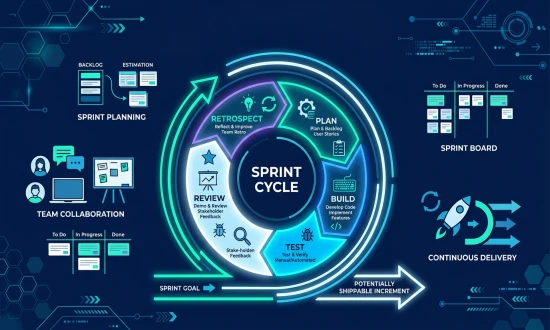
Scrum is by far the most widely used agile framework. It organizes work into fixed-length iterations called sprints, typically two weeks long, during which a cross-functional team works to deliver a potentially shippable increment of the product. Scrum defines three roles: the Product Owner, who owns the product backlog and prioritizes work based on business value; the Scrum Master, who facilitates the process and removes impediments; and the Development Team, which self-organizes to deliver the sprint goal.
Scrum's ceremonies create a rhythm of planning, execution, and reflection. Sprint Planning establishes what the team will work on and how. The Daily Scrum (or standup) provides a brief daily synchronization point. The Sprint Review demonstrates the completed work to stakeholders and gathers feedback. The Sprint Retrospective gives the team a dedicated space to reflect on their process and identify improvements.
The product backlog — a prioritized list of everything the product needs — is the central artifact of Scrum. Items in the backlog are refined collaboratively, estimated, and pulled into sprints based on priority and team capacity. This continuous refinement process replaces the upfront comprehensive requirements documentation of waterfall, allowing requirements to evolve as understanding deepens.
Kanban — Continuous Flow for Continuous Work
Where Scrum organizes work into time-boxed iterations, Kanban organizes work as a continuous flow. Originating in Toyota's lean manufacturing system, Kanban visualizes work on a board with columns representing stages of the workflow — To Do, In Progress, Review, Done — and limits the amount of work allowed in each stage (Work In Progress limits, or WIP limits).
WIP limits are the defining practice of Kanban and the source of much of its power. By capping how many items can be in any given stage simultaneously, WIP limits prevent the team from starting more work than it can finish — a common failure mode in software teams that start many things and finish few. When a WIP limit is hit, the team is forced to swarm on completing in-progress work before pulling new work in, improving flow and reducing the cycle time from start to done.
Kanban is particularly well-suited to operational and support work — bug fixing, maintenance, and other work that arrives unpredictably and cannot be easily batched into two-week sprints. Many teams use hybrid approaches, applying Scrum for planned feature development and Kanban principles for unplanned work.
Scaling Agile — SAFe and LeSS
Agile was originally designed for small, co-located teams. As organizations sought to apply agile principles at scale — across dozens or hundreds of teams working on large, interconnected systems — scaling frameworks emerged to address the coordination challenges that arise.
The Scaled Agile Framework (SAFe) is the most widely adopted scaling approach. It organizes teams into Agile Release Trains (ARTs) — groups of 50–125 people that plan, commit, and execute together on a Program Increment (PI) of 8–12 weeks. SAFe provides structures for portfolio management, architectural alignment, and enterprise-level prioritization that Scrum and Kanban do not address.
Large-Scale Scrum (LeSS) takes a more minimalist approach, extending Scrum's practices to multiple teams with as little additional process as possible. LeSS advocates for a single product backlog shared across all teams, a single Product Owner, and coordination mechanisms that emerge from the teams rather than being imposed structurally.
Both frameworks involve trade-offs. SAFe's comprehensiveness provides structure but can introduce bureaucracy that slows the very agility it is meant to enable. LeSS's minimalism maintains agility but requires significant organizational maturity and discipline to work at scale.
Agile and Quality
A common misconception is that agile and quality are in tension — that moving fast means cutting corners. This misconception typically reflects poor agile implementation rather than any inherent trade-off. In well-implemented agile, quality practices are embedded into the definition of done: code is not complete until it is tested, reviewed, integrated, and demonstrably working. Test-Driven Development, continuous integration, automated testing, and regular code review are all agile practices that directly support quality.
The sprint review — where the team demonstrates working software to stakeholders every two weeks — creates a regular quality feedback loop that waterfall projects lack entirely until the final acceptance phase. Defects discovered two weeks after they are introduced are far easier to fix than defects discovered six months later. Agile's short cycles make quality problems visible quickly, enabling faster correction.
Common Agile Anti-Patterns
Despite its widespread adoption, agile is frequently implemented poorly. "Cargo cult agile" — adopting the ceremonies and terminology of Scrum without the underlying values — is pervasive. Daily standups become status reports to management rather than team synchronization events. Retrospectives are skipped when teams are busy — precisely when they are most needed. The sprint becomes a miniature waterfall, with requirements locked at the start and no room for learning or adaptation.
"Agile in name only" organizations often impose agile practices on teams while retaining waterfall governance structures: fixed scope, fixed budget, fixed deadline, with agile ceremonies adding overhead without delivering the flexibility they promise. True agile requires organizational commitment to empirical planning, genuine prioritization authority for Product Owners, and tolerance for the uncertainty that iterative development inherently involves.
Measuring Agile Success
Agile teams should measure outcomes, not activity. Velocity — the number of story points completed per sprint — is a planning tool, not a performance metric. Teams that optimize for velocity inflate estimates, cut quality corners, and game the measurement rather than improve their actual capability.
Meaningful agile metrics include: lead time (how long from idea to production), cycle time (how long work takes once started), deployment frequency, change failure rate, and customer satisfaction measures. These outcome-focused metrics align with the DORA metrics and reflect the agile philosophy of valuing working software and customer collaboration over process compliance.
Conclusion
Agile methodologies represent a fundamental shift in how the software industry thinks about planning, collaboration, and delivery. By embracing change rather than resisting it, delivering working software in short cycles rather than big-bang releases, and building cross-functional teams with genuine ownership of their work, agile-practicing organizations consistently outperform their waterfall counterparts on speed, quality, and customer satisfaction. The journey to genuine agility is not easy — it requires cultural change, organizational commitment, and continuous improvement over time. But for teams willing to make that investment, agile is not just a development methodology. It is a competitive advantage.