


Introduction
When most people think about RFID, they picture the hardware: the tiny chip embedded in a label, the handheld reader scanning a warehouse shelf, the antenna mounted above a highway lane. But hardware alone does nothing useful. It is the software layer — the middleware, APIs, databases, and analytics platforms built on top of raw RFID signals — that transforms a stream of tag reads into business intelligence, automated workflows, and real-time decisions.
For software developers, RFID represents a rich integration challenge. Reading a tag is trivial; building a system that reliably captures millions of reads per day, filters out noise, deduplicates events, stores structured data, exposes it through APIs, and feeds it into enterprise applications is anything but. This article explores the major software application domains where RFID is driving innovation, and the engineering patterns that make those applications possible.
The RFID Software Stack: An Overview
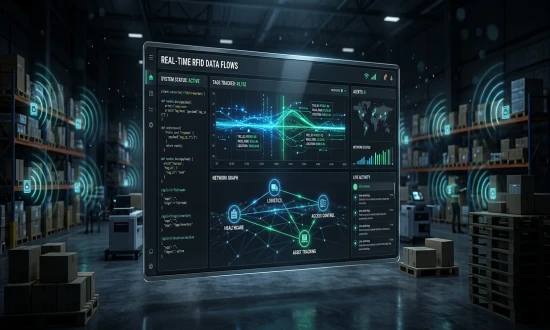
Before diving into specific applications, it helps to understand how RFID data flows through a typical software architecture. The stack generally has four layers:
- Edge layer: Firmware running on readers and gateways that manages antenna control, air protocol (EPC Gen2, ISO 15693, etc.), and raw tag event generation.
- Middleware layer: Software such as Impinj Octane SDK, LLRP-compliant readers, or custom agents that filter, aggregate, and forward tag events to higher layers. This is where duplicate reads are collapsed, signal noise is filtered, and zone-based logic is applied.
- Application layer: The business logic tier — inventory management systems, WMS platforms, hospital asset trackers, ERP connectors — that consumes clean RFID events and acts on them.
- Analytics and reporting layer: Dashboards, machine learning pipelines, and reporting tools that turn historical RFID data into trends, forecasts, and alerts.
Most real-world RFID software projects spend the majority of their engineering effort in the middleware and application layers, where the complexity of real-world deployments becomes apparent.
Inventory Management Systems
The most widespread RFID software application is inventory management. Retailers, manufacturers, and logistics operators deploy RFID-enabled inventory systems to achieve accuracy and speed impossible with manual counting or barcode scanning.
From a software perspective, the core challenge is item-level event processing. A single UHF RFID reader can generate thousands of tag reads per second. A naive system that logs every read would rapidly accumulate redundant data and become unusable. Effective inventory software applies several techniques:
Event deduplication: The same tag may be read dozens of times per second as it sits in a reader’s field. Middleware collapses repeated reads of the same EPC within a configurable time window into a single logical “seen” event.
Zone inference: Readers positioned at specific locations allow software to infer which zone an item occupies. Transition logic detects when a tag moves from one zone to another, generating movement events rather than raw reads.
Reconciliation engines: Inventory software compares the current observed state of RFID-tagged items against the expected state in a master database, surfacing discrepancies as actionable alerts — items missing from a shelf, items in the wrong location, or unexpected items detected.
Modern inventory platforms expose these capabilities through REST or GraphQL APIs, allowing integration with ERP systems like SAP, Oracle, and Microsoft Dynamics. Cloud-native implementations on AWS, Azure, and Google Cloud leverage managed IoT services — such as AWS IoT Core — to handle the ingestion and routing of high-volume RFID event streams.
Warehouse Management and Logistics Software
Warehouse Management Systems (WMS) represent one of the highest-value RFID software integration domains. When pallets, cases, and individual items carry RFID tags, and when readers are deployed at dock doors, conveyor choke points, and storage locations, a WMS gains a real-time, autonomous view of the warehouse that was previously achievable only through costly manual labor.
Key software capabilities in RFID-enabled WMS platforms include:
- Automated receiving: As a pallet passes through a dock door equipped with a portal reader, the system automatically identifies every tagged case on the pallet, compares the read list against the advance ship notice (ASN), and generates a receiving record — without a worker scanning a single barcode.
- Slotting optimization: Continuous RFID location data feeds into algorithms that analyze pick frequency, travel time, and storage density to recommend optimal slot assignments for high-velocity SKUs.
- Real-time task interleaving: Knowing exactly where every item and every picker is at all times allows the WMS to dynamically assign tasks, reducing deadhead travel and improving throughput.
- Exception management: Automated alerts when items are detected in unauthorized locations, when shipments depart with incorrect contents, or when dwell times exceed thresholds.
Leading WMS platforms including Manhattan Associates, Blue Yonder, and SAP Extended Warehouse Management offer native RFID integration modules. Middleware layers such as Zebra’s Savanna platform abstract the heterogeneity of reader hardware behind standardized APIs.
Healthcare Software Applications
Healthcare is arguably the domain where RFID software failures carry the highest human cost, and where thoughtful software engineering has the greatest potential to improve outcomes.
Asset Tracking Platforms
Hospital asset tracking software continuously monitors the location of mobile equipment — infusion pumps, wheelchairs, ventilators, ECG monitors — tagged with active or battery-assisted passive RFID tags. The software maintains a real-time location map, exposes a search interface for nurses to find equipment in seconds, and generates utilization analytics that help procurement teams make evidence-based equipment purchasing decisions.
These platforms integrate with nurse call systems, electronic health records (EHR), and facilities management software. RESTful APIs allow third-party applications to query equipment location programmatically, enabling use cases like automatically routing the nearest available wheelchair to a patient discharge room.
Surgical Instrument Tracking
Surgical count software integrates RFID readers built into instrument trays and sterilization equipment. Before and after each procedure, the software automatically compares the instrument set against a predefined tray configuration, flagging any missing or extra items. This digitizes a process that has historically depended entirely on manual counting — a process susceptible to fatigue-related errors.
Integration with the electronic medical record creates an auditable chain of custody for every instrument, from sterilization to procedure to reprocessing. Regulatory bodies in several countries now recognize RFID-based instrument tracking as a valid component of retained surgical item prevention protocols.
Medication Management
Pharmacy and medication dispensing software uses RFID to enforce the “five rights” of medication administration: right patient, right drug, right dose, right route, right time. RFID-tagged medication packages are verified by readers at dispensing cabinets and at the bedside, with software blocking administration and alerting staff if any parameter does not match the active medication order in the EHR.
Access Control and Identity Management Software
Access control is one of the oldest and most mature RFID software application domains. Modern physical identity management platforms have evolved far beyond simple door unlock logic into comprehensive systems that manage the full lifecycle of credential issuance, access policy enforcement, audit logging, and integration with logical (IT) security infrastructure.
Software capabilities in modern access control platforms include:
- Role-based access policy engines that define which credential holders can access which zones during which time windows, with policy changes propagating to door controllers in real time.
- Anomaly detection algorithms that flag unusual patterns — a credential used in two geographically separated locations within an impossible time window (indicating cloning), or a high volume of failed reads suggesting an unauthorized access attempt.
- Integration with Active Directory and LDAP, so that when an employee is offboarded in HR systems, their physical access credentials are automatically revoked across all connected readers.
- Visitor management modules that issue temporary RFID credentials with granular time and zone restrictions, automatically expiring after the visit window closes.
The convergence of physical and logical access control — using the same RFID credential to unlock a door and authenticate to a corporate VPN — is an active area of development, with standards like PACS (Physical Access Control Systems) interoperability frameworks gaining traction.
IoT Integration and Real-Time Data Pipelines
As RFID deployments scale, the volume of data generated can be enormous. A large distribution center with hundreds of readers processing millions of tag reads per hour requires purpose-built data engineering to turn that fire hose into usable intelligence.
Modern RFID IoT architectures commonly adopt event-driven patterns using message brokers such as Apache Kafka or AWS Kinesis to ingest raw tag events at scale. Stream processing frameworks like Apache Flink or Spark Streaming apply stateful logic — deduplication windows, zone transition detection, dwell time calculation — to the real-time stream, emitting clean, semantically rich events to downstream consumers.
These clean events feed into a variety of sinks:
- Time-series databases (InfluxDB, TimescaleDB) for location history and utilization trend analysis.
- Operational data stores for real-time query by WMS, ERP, and other transactional systems.
- Data lakes (S3, Azure Data Lake) for long-term retention, compliance, and machine learning training datasets.
- Alerting systems that trigger notifications, workflow actions, or API calls when specific conditions are detected in the event stream.
The adoption of MQTT and AMQP protocols for edge-to-cloud communication, combined with containerized microservices architectures and Kubernetes orchestration, means that modern RFID software platforms are increasingly indistinguishable in their architecture from any other large-scale IoT data platform.
Machine Learning and Predictive Applications
The richness of RFID data — granular, timestamped, location-aware, and continuous — makes it an excellent input for machine learning applications that go beyond simple tracking.
Demand forecasting: Retail RFID data showing how quickly individual SKUs move off shelves, how long items sit in back-of-house before being replenished, and how inventory levels correlate with sales velocity provides training signals for forecasting models that significantly outperform models trained on point-of-sale data alone.
Predictive maintenance: In manufacturing, RFID tags on tooling and equipment components, combined with sensor data, feed machine learning models that predict failure before it occurs, enabling maintenance scheduling that minimizes unplanned downtime.
Patient flow optimization: In hospitals, RFID location data for patients, staff, and equipment feeds models that predict bottlenecks in care pathways, allowing administrators to allocate resources proactively rather than reactively.
Anomaly detection: Unsupervised learning models trained on normal RFID movement patterns in a facility can surface anomalies — unusual dwell times, unexpected item routes, or atypical access patterns — that may indicate theft, process breakdown, or security incidents.
Conclusion
RFID technology is only as powerful as the software built to interpret it. The chip and antenna deliver an identifier; everything else — the meaning of that identifier, the actions it triggers, the intelligence it generates — is a software problem. As RFID hardware becomes cheaper, smaller, and more capable, the competitive differentiation in RFID-enabled systems will increasingly come from software: from the sophistication of event processing pipelines, the quality of API design, the accuracy of predictive models, and the usability of the interfaces through which humans consume RFID-derived insights.
For software engineers, RFID sits at a fascinating intersection of embedded systems, distributed data engineering, enterprise integration, and applied machine learning. Building well in this space requires deep understanding of both the physical constraints of radio frequency communication and the architectural patterns of modern cloud-native software. The organizations that master this combination will hold a significant operational advantage in the decade ahead.